
Hemp is one of humanity's oldest cultivated crops. In the United States, it went from required to forbidden to legal again in under 400 years.
Timeline
- 1619The Virginia Assembly requires farmers to grow hemp.
- 1700sGeorge Washington grows hemp at Mount Vernon.[13]
- 1800sKentucky becomes a leading hemp state; the Navy depends on hemp rigging and sails.
- 1916USDA Bulletin 404 studies hemp hurds as a paper-making material.[3]
- 1937The Marihuana Tax Act effectively ends commercial hemp farming.
- 1942USDA's film Hemp for Victory urges farmers to grow hemp for WWII.[10]
- 1970The Controlled Substances Act lists all cannabis, including hemp, in Schedule I.
- 2014The Farm Bill allows state hemp research pilot programs.
- 2018The Farm Bill legalizes hemp with 0.3% or less delta-9 THC.[1]
- 2025The U.S. hemp crop is valued at $739 million.[2]
- 2026A new federal hemp definition takes effect on December 11.[11]
Colonial America: hemp as a necessity
In 1619 the Virginia Assembly required every farmer to grow hemp. Rope, sails, clothing and paper made it vital for survival and trade, and in some colonies hemp could even be used to pay debts and taxes.
The Founders grew hemp
George Washington grew hemp at Mount Vernon for fiber,[13] and Thomas Jefferson also grew and wrote about the crop. It was an everyday farm crop of the early republic.
The 1800s: America's hemp heartland
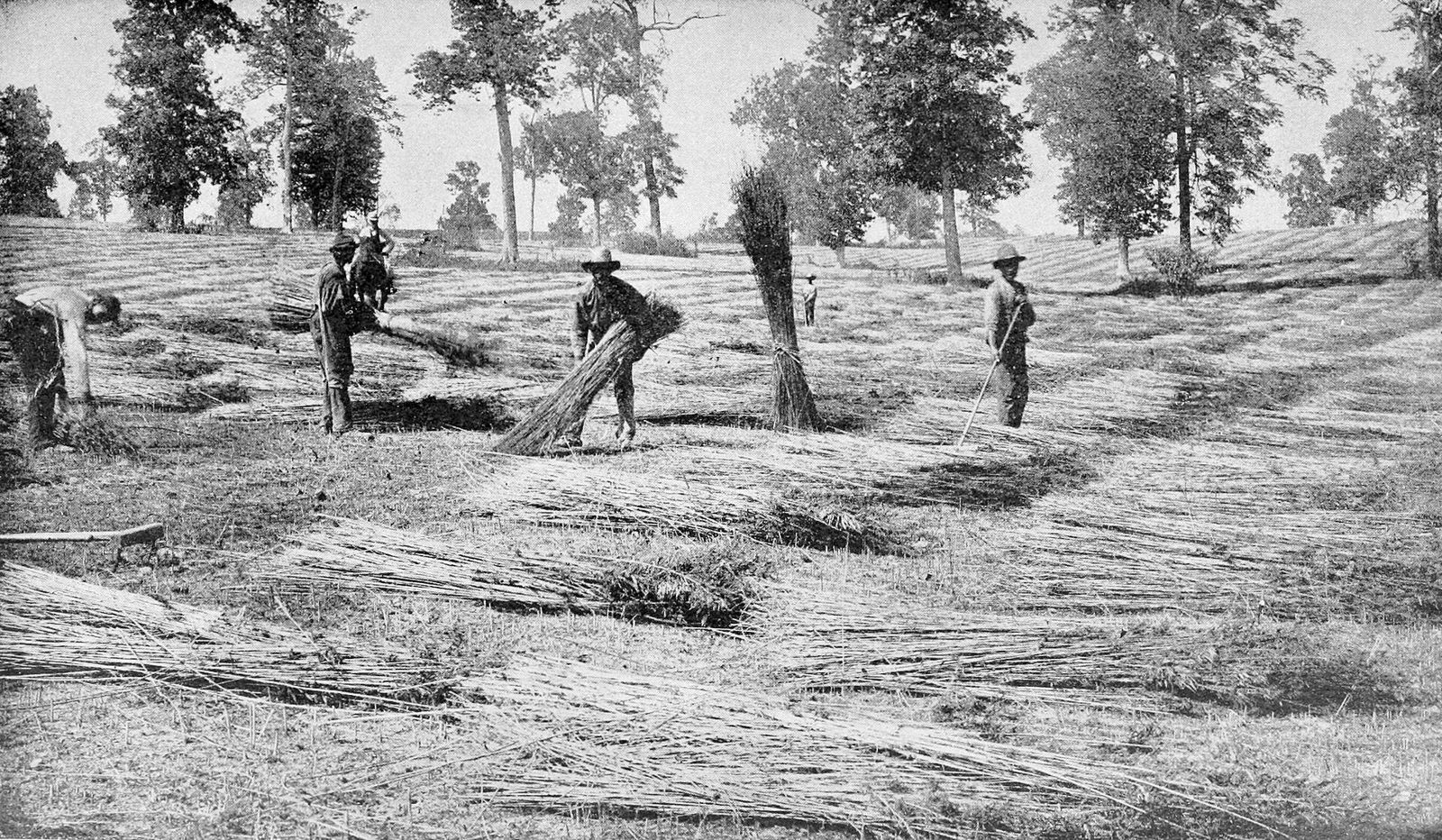
Kentucky, Missouri and Illinois led U.S. hemp production, and the Navy relied on hemp for rigging and sails. Hemp's history also includes a painful truth: on plantations, enslaved people were forced to do the hard labor of processing the crop.
1900–1937: propaganda and prohibition
Early 20th-century propaganda, much of it racist, conflated hemp with marijuana. The 1937 Marihuana Tax Act placed all cannabis under heavy taxes and rules, and commercial hemp farming collapsed.
1942: Hemp for Victory
When World War II cut off imported fiber, the U.S. reversed course. USDA's film Hemp for Victory urged farmers to grow hemp for rope, thread and webbing the military needed.[10]
1950s–1990s: lockdown
After the war, hemp faded. In 1970 the Controlled Substances Act placed hemp in Schedule I alongside marijuana, while much of the world kept growing and studying it.
2014–today: the comeback
State activism and research brought hemp back. The 2014 Farm Bill allowed research pilots, and the 2018 Farm Bill legalized hemp with 0.3% or less delta-9 THC.[1] Today hemp is studied for carbon-storing buildings, regenerative agriculture and bio-based plastics.
Myth check
Was the Declaration of Independence written on hemp paper? No. According to the U.S. National Archives, it was written on parchment (animal skin).[12]
Does hemp have "25,000 uses"? The figure traces to a 1938 Popular Mechanics article and is not a measured count.[20] Hemp's real uses are impressive enough.